A Strong M.Com Programme Matters in Today’s Commerce Education

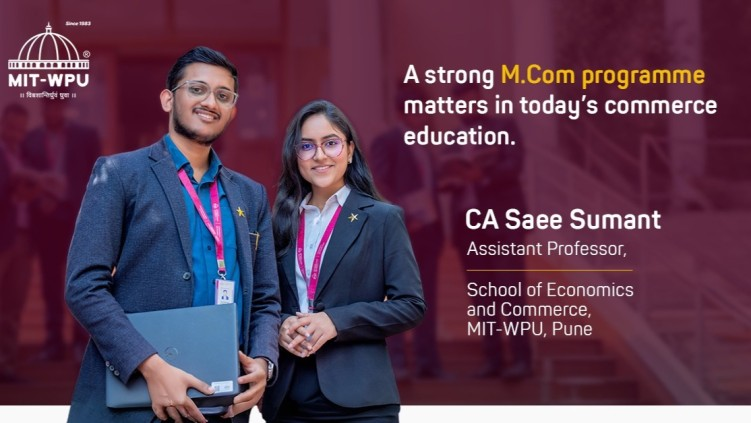
The role of commerce education has changed. A postgraduate degree now cannot be confined to only theoretical knowledge, but also periodic examinations like conventional classroom learning. The demands of modern practice require a better understanding of accounting, finance, taxation, research methods, business decision-making and professional ethics for students entering the field today.
The ability to adjust in a world that is changing and the willingness to learn in a workplace where subject knowledge is no longer sufficient also necessitate confidence. And this requires students to be confident enough to operate in constantly-changing environments, where employers want more than just a fundamental knowledge of their subject.
That is why the M.Com pathway matters so much. At MIT-WPU, Pune, the postgraduate commerce journey is designed as a serious academic and professional bridge, not merely as an extension of undergraduate study. The Department of Commerce & Accounting offers M.Com as a two-year postgraduate programme within a broader commerce portfolio that also includes B.Com and PhD pathways.
Academic rigour remains the backbone of postgraduate commerce learning
Any strong M.Com programme must begin with academic rigour. Students at this level need to be challenged to think critically, question trends, and use concepts more purposefully.
The MIT-WPU, Pune, M.Com programme is structured around that principle. It uses a hybrid learning format, and it is built around research-based learning, practical application, case studies, and real-world experience.
That matters because commerce education becomes most valuable when students are not only learning concepts, but also learning how to use them in actual professional situations. The programme is also designed with a wide range of elective subjects, allowing students to move beyond a one-size-fits-all structure and shape their learning more intentionally.
At the postgraduate level, intellectual rigour is not just about difficulty. It is about depth. It is about empowering students to discover why a financial decision was prescribed, how a market behaves, what tools are used to measure risk and how business knowledge can be used ethically. The M.Com structure at MIT-WPU, Pune, embodies that approach with a huge stress on core commerce subjects along with analytical and application-centric learning. Instead of learning, teach them how to learn.
Reason-based studying results in students transforming into logical thinkers
One of the strongest features of a good M.Com programme is its ability to create independent thinkers. Students should not only memorise material; they should learn how to investigate problems, read data carefully, and form reasoned conclusions.
The M.Com programme at MIT-WPU, Pune, is designed with that kind of research orientation. It includes research methodology in the curriculum and uses teaching methods grounded in research and case studies. That matters, because research approaches are not only an academic preparation for students teaching dissertations or doctoral studies. It also enhances judgement, clarity of analysis and problem-solving competency in professional life.
That shift is reinforced by the organisation of the coursework. Topics covered in semester learning include Managerial Economics, Legal Aspects of Business, Management Accounting, Research Methodology, Auditing & Taxation, Financial Management (only for 2nd year), Financial Modelling (for 1st years only), International Finance, Statistical Methods & Quantitative Techniques, Advanced Financial Reporting, Personal Financial Planning, Capital Market and Financial Services, and Strategic Management. This framework helps in making students think of commerce as a continuously changing, dynamic discipline rather than merely a fading set of knowledge.
Global certification adds real value to postgraduate commerce
In today’s world, postgraduate commerce education becomes stronger when it is connected to globally recognised qualifications. MIT-WPU, Pune, has built this logic into the M.Com pathway by offering students the option to pursue the Investment Foundations Certificate from the CFA Institute, USA. This is a meaningful addition because it gives students exposure to investment concepts and financial analysis through an internationally respected framework. It also helps bridge the gap between academic theory and professional practice.
This kind of certification matters for more than one reason. First, it strengthens conceptual understanding. Second, it gives students a credential that signals seriousness and industry awareness. Third, it broadens the student’s exposure to global financial thinking at a stage when many others are still focused only on conventional postgraduate coursework. At MIT-WPU, Pune, the value of this certification lies not just in the certificate itself, but in the habit of thinking professionally from the beginning of the postgraduate journey.
Practical application ensures that learning does not remain abstract
In the case of commerce, which is relevant in the sense that students must apply ideas to be able to use them in business scenarios. Hence, the M.Com programme that is quite application-oriented at MIT-WPU, Pune requires special mention. Learning model comprises of industry visits, guest lectures, seminars, workshops led by eminent corporate leaders from the Big Four and skill-development institutes involved in live industry projects. This is a much clearer picture of how commerce works in the real world for students.
This is increasingly valuable given that postgraduate students already know the basics of the discipline. They need to see financial reporting in action, how tax is dealt with in a business context; understanding how financial modelling guides decision-making, and lastly, how analysis is only meaningful when it interfaces with context. The M.Com curriculum at MIT-WPU, Pune, helps to ease that transition. It explicitly links academic study to the field, so students are oriented for employment early on and are practical by graduation.
Specialisation tracks guide students in the right direction
An M.Com programme designed properly should not just teach students some general awareness. And also having them delve deep into fields that are relevant to their desires. That depth is provided through professional elective tracks such as Accounting Theory and Financial Reporting, Material, Labour and Overhead Costing, Treasury Management, Partnership and Special Accounts, Methods and Control Techniques of Costing (two subjects) and Strategic Financial Management by institutions like the MIT-WPU, Pune. These tracks enable a comprehensive graduate education beyond the core and allow students to explore areas of particular interest that align with their career goals.
This flexibility is one of the strongest points of this postgraduate commerce education. Reporting and accounting systems interest some students. There are also those interested in cost structures and treasuries, financial planning or what we would call strategic finance. A programme which provides these tracks allows students to pursue learning with purpose. Even better, it connects the learning with how they want to progress in their career.
Industry relevance leads to enhanced confidence and employability
So the best postgraduate programmes do more than prepare for exams. They prepare them for work. This is something which the M.Com programme at MIT-WPU, Pune, is also aligned with. This combines promising features of an industry-relevant curriculum with live projects, apart from different unique certifications and skill-development courses, such as Forensic Accounting and Advanced MS Excel, Financial Modelling, and Six Sigma, to get them ready in a competitive world. Likewise, it provides 100% placement support through its compulsory internship assistance so as to aid students stepping into higher job segments.
This is an important career path as postgraduate students tend to look beyond academia. They want a programme that prepares them to be employable, confident and slick on the field. In that sense, the M.Com route at MIT-WPU, Pune, is more than content. It offers transition. It prepares students to enter the world of accounting, finance, consulting and management with a new perspective into what they will be doing outside of the classroom.A wide range of career outcomes makes the programme more valuable
One of the most attractive qualities of the M.Com route at MIT-WPU, Pune, is the range of roles it supports. Careers after this programme include Accountant, Investment Banker, Investment Analyst, and Management Consultant. Business Analysts, Financial analysts, Securities analyst, Risk analyst & Tax Consultant, Wealth Manager, Business Developer, Marketing Analysts, Research Analyst, Research Assistant and Assistant Professor (NET/SET). That breadth is important because it demonstrates the degree's versatility. No, that qualification is not narrow. It is a futures-compatible platform.
This set of outcomes is particularly relevant for students because it strikes a balance between stability and option value. Some want jobs in the industry. Some might be looking to shift into education or research. Few might even get into professional certifications or higher studies. All these paths are supported by a strong M.Com programme that provides you with a solid base academically and professionally.
The return on investment is strengthened by structure, depth, and support
Higher education must justify itself not only academically, but also professionally. The M.Com programme at MIT-WPU, Pune, is structured to offer strong value through a combination of academic depth, global certification, practical learning, and career support. It is a two-year programme, and it also offers scholarships for eligible students. The admission process is based on eligibility criteria and Personal Interaction, which keeps the selection pathway focused and transparent.
This matters because students and families increasingly look at postgraduate education through the lens of long-term return. A programme that strengthens academic capability, expands career possibilities, and adds recognised professional value offers a stronger return than one that only delivers classroom instruction. MIT-WPU, Pune’s M.Com framework does precisely that. It combines affordability, relevance, and rigour in a way that speaks to the needs of modern commerce students.
Conclusion
A modern M.Com programme must do several things at once. It must build academic rigour, encourage research, strengthen practical understanding, connect students with industry, and create a pathway to meaningful careers. The M.Com programme at MIT-WPU, Pune, brings these elements together in a well-structured postgraduate experience. With its hybrid learning model, research-based pedagogy, practical exposure, global certification option, elective flexibility, and career-oriented support, it offers students a serious and future-facing commerce education.
For students who want to grow into professionals who can think clearly, work responsibly, and adapt to an evolving business landscape, this kind of programme matters. It does more than educate. It prepares, shapes, and opens doors. That is what makes a strong M.Com pathway valuable, and that is what makes the M.Com journey at MIT-WPU, Pune, worth considering.


 admissions@mitwpu.edu.in