Building Smarter with UHPFRC: Strength, Durability and Sustainability

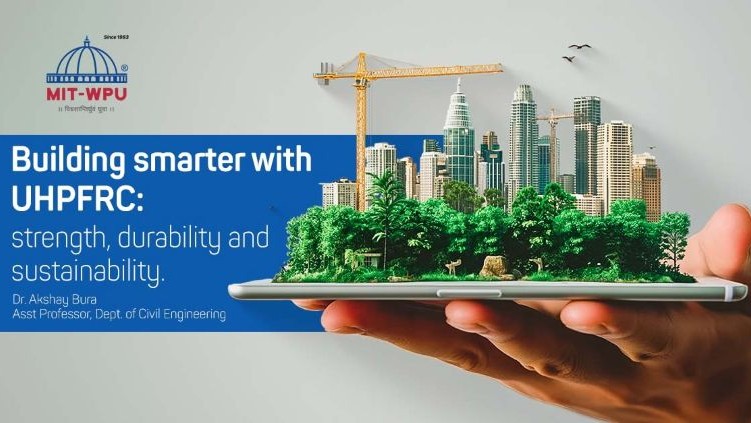
In civil engineering, we often teach students that a material is never just a material. It carries within it questions of strength, safety, service life, cost, maintenance, sustainability and human responsibility.
Concrete is the best example of this. It has shaped cities, bridges, tunnels, ports, homes and public infrastructure for more than a century. Yet, as infrastructure becomes more complex and climate conditions become more demanding, conventional concrete is being asked to perform under pressures it was never fully designed for.
This is where Ultra-High-Performance Fibre-Reinforced Concrete, or UHPFRC, becomes important.
That said, this is not just a more advanced version of concrete. That would be an incomplete view. UHPFRC is a change in our approach to durability, material use efficiency and long-term performance of infrastructure.
Strength Is Only the Starting Point
The most talked about property of UHPFRC is its strength. The Federal Highway Administration defines Ultra-High-Performance Concrete as concrete with a compressive strength greater than 150 MPa and post-cracking tensile strength greater than 5 MPa sustained after cracking. Its fibre reinforcement also helps the material retain its performance after cracking, which is a significant advantage over conventional concrete in demanding applications.
For students, these numbers are impressive. But as faculty members, we must go beyond the number.
High compressive strength means slimmer sections can be designed. Higher tensile capacity and improved crack control mean the material can behave with greater reliability under stress. Better ductility means the structure can respond more intelligently under load rather than failing in a brittle manner.
In simple terms, UHPFRC allows engineers to design not only for strength, but for performance.
This distinction is very important. A bridge girder, a tunnel lining, a marine deck or a precast structural unit is not judged only on whether it stands on the day it is built. It must continue to perform for decades, often under aggressive exposure conditions.
The Real Power of UHPFRC Is Durability
One of the most remarkable aspects of UHPFRC is its dense microstructure. Conventional concrete has interconnected pores that allow water, chlorides, carbon dioxide and other harmful agents to enter over time. Once these agents reach the reinforcement, corrosion begins. Cracking, spalling and structural deterioration often follow.
UHPFRC changes this behaviour significantly.
The FHWA notes that UHPC has a discontinuous pore structure that reduces liquid ingress and enhances durability when compared with conventional and high-performance concretes. This matters greatly in infrastructure exposed to chlorides, moisture, freeze-thaw cycles, chemical attack and marine conditions.
In teaching material science and structural durability, we often remind students that deterioration is usually not sudden. It is gradual. It begins quietly through permeability, microcracking and environmental exposure. By the time visible damage appears, the structure may already have lost years of service life.
UHPFRC helps us intervene much earlier in that chain of deterioration.
Sustainability Is About the Full Life Cycle
There is a common concern that UHPFRC contains higher cement content and therefore may appear less sustainable at the material production stage. This concern is valid, but it is also incomplete.
Sustainability in civil engineering cannot be judged only by the amount of cement used per cubic metre. It must be studied across the full life cycle of the structure.
If a material allows thinner sections, reduced reinforcement, fewer repairs, lower maintenance frequency and longer service life, then its environmental performance must be evaluated over decades, not only at the time of construction.
This is especially important because cement manufacturing itself is a major contributor to emissions. Recent studies and industry assessments continue to place cement-related emissions at nearly 7 to 8% of global anthropogenic CO₂ emissions. Therefore, the future of concrete cannot be about using more material blindly. It must be about using better material more intelligently.
A 2025 comparative life cycle assessment of UHPFRC bridge overlays found that a UHPFRC overlay reduced CO₂ emissions by 34% compared with conventional steel fibre-reinforced concrete, with 40 to 67% lower energy use due to thinner overlays and longer service life. This does not mean UHPFRC is automatically the best choice for every project. It means that when used in the right application, its life-cycle advantages can be significant.
That is the kind of sustainability thinking civil engineers must develop.
Why Infrastructure Needs Materials Like UHPFRC
India’s infrastructure story is moving at a large scale. CRISIL has projected that India will spend nearly ₹143 lakh crore on infrastructure between fiscals 2024 and 2030, more than double the spending in the previous seven-year period. Of this, nearly ₹36.6 lakh crore is expected to go into green investments.
This level of investment cannot be supported by conventional thinking alone. Roads, bridges, metros, tunnels, airports, ports, industrial corridors and urban infrastructure will need materials that can deliver strength, speed, durability and lower maintenance over time.
UHPFRC is especially relevant in bridge preservation and repair, precast connections, marine structures, tunnels, high-rise buildings, industrial floors and next-generation smart infrastructure. The FHWA has also identified UHPC as useful for bridge preservation and repair because of its durability, improved life-cycle cost performance and long-lasting repairs. In some cases, UHPC repairs can even allow bridges to reopen to traffic within 24 hours after completion, depending on the mix and repair situation.
For a country building at speed, this kind of performance is not a luxury. It can become an engineering necessity.
But UHPFRC Is Not a Shortcut
As engineers, we must also be careful not to romanticise any material.
UHPFRC is not a magic solution. It requires proper mix design, quality control, curing, fibre distribution, testing, skilled application and a clear understanding of structural behaviour. Its cost must be justified by performance. Its use must be based on engineering need, not fashion.
This is where the role of research becomes important.
Students and young engineers must learn how to evaluate materials scientifically. They must ask: What is the exposure condition? What is the design life? What is the failure risk? What is the maintenance strategy? What is the life-cycle carbon impact? What are the long-term costs?
Only then can a material such as UHPFRC be used responsibly.
The Future Civil Engineer Must Think Differently
The civil engineer of the future will not work only with cement, steel, aggregates and drawings. They will work with advanced materials, digital modelling, sustainability metrics, life-cycle assessment, performance-based design and smart infrastructure systems.
This is why postgraduate learning becomes valuable.
MIT-WPU, Pune’s M.Tech Civil Engineering pathways, including Structural Engineering and Construction Engineering and Management, are designed to help students build advanced technical, analytical, research and sustainability-oriented capabilities. The Structural Engineering programme highlights research areas such as sustainable construction, advanced laboratories and computer simulation methods, while Construction Engineering and Management focuses on construction technology, project management, sustainable practices, internships and practical application.
For students who are passionate about materials such as UHPFRC, such learning can open pathways into structural design, infrastructure research, advanced construction materials, durability studies, precast technology, repair and rehabilitation, and sustainable infrastructure development.
Building Smarter, Not Just Stronger
The future of infrastructure will not be defined only by how much we build. It will be defined by how intelligently we build.
UHPFRC teaches us an important lesson. Strength is important, but strength alone is not enough. Durability matters. Maintenance matters. Material efficiency matters. Carbon impact matters. The service life of a structure matters.As faculty members, our responsibility is to help students see this larger picture. We must train them to look at materials not as textbook chapters, but as decisions that influence the safety, economy and sustainability of real infrastructure.
UHPFRC is one of the materials that can help civil engineering move towards that future. It offers strength, crack control, durability and life-cycle value. But its true potential will be realised only when it is used by engineers who can combine technical knowledge with judgement.
That is the future we must prepare for - not just stronger structures but smarter, more durable and more responsible infrastructure.


 admissions@mitwpu.edu.in