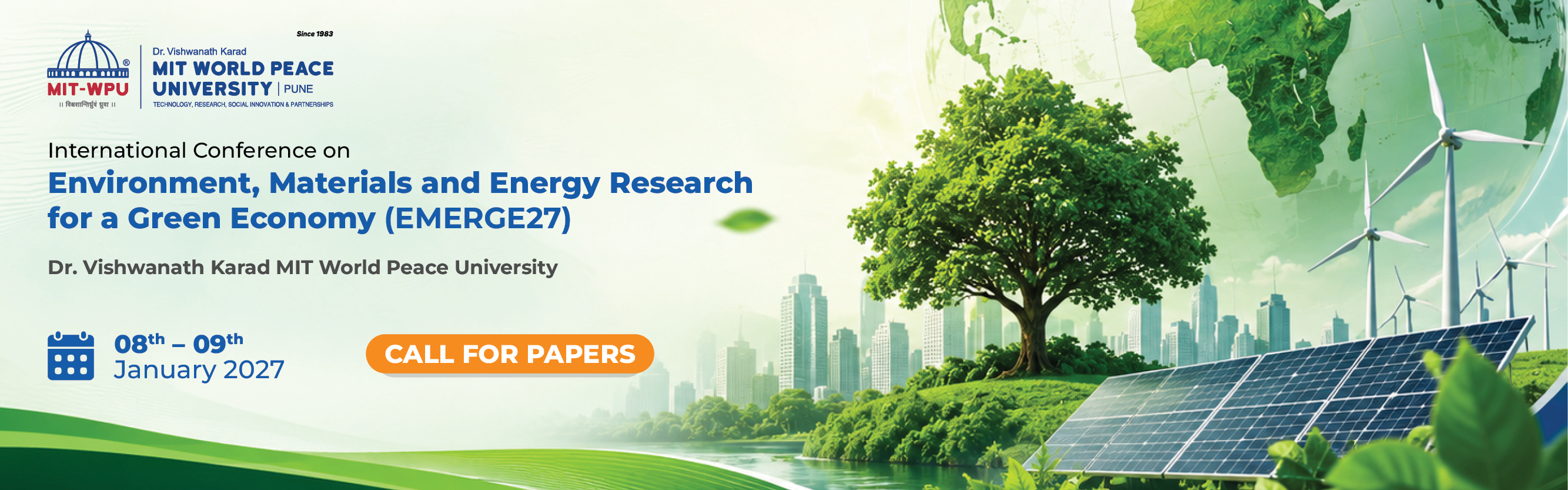
ABOUT THE EMERGE-2027
The International Conference on Environment, Materials and Energy Research for a Green Economy (EMERGE-2027) is envisioned as a premier global forum for presenting and discussing the latest advancements in sustainable technologies, environmental protection, advanced materials, renewable energy systems, climate resilience, and green industrial practices.
Inspired by the United Nations Sustainable Development Goals (SDGs), EMERGE-2027 seeks to encourage scientific discussions that contribute to:
- Sustainable Development
- Climate Action
- Clean Energy Transition
- Green Manufacturing
- Circular Economy
- Resource Efficiency
- Carbon Neutrality
- Environmental Conservation
The conference will provide opportunities for researchers and industry experts to exchange ideas, establish collaborations, and develop innovative solutions for building a sustainable future. This aligns with international conference models such as ICAME 2026, which emphasize SDG-driven research, sustainability, renewable energy, and climate-resilient technologies.
- International Keynote Speakers
- Invited Expert Talks
- Industry-Academia Interaction
- Technical Sessions
- Young Researcher Forum
- Best Paper Awards
- Networking Opportunities
- Hybrid Participation Facility
- Promote cutting-edge research in Environment, Materials, and Energy.
- Encourage academia-industry collaboration.
- Facilitate interdisciplinary knowledge exchange.
- Showcase emerging technologies supporting a Green Economy.
- Support research aligned with UN Sustainable Development Goals.
- Create opportunities for international networking and partnerships.
- Encourage innovation-driven solutions for global sustainability challenges.
- Foster collaborations among researchers, policymakers, industries, and entrepreneurs.
- Advanced Materials Science and Engineering
- Nanomaterials and Nanotechnology
- Biomaterials and Biomedical Engineering
- Smart, Functional and Quantum Materials
- Sustainable, Green and Eco-friendly Materials
- Composite, Polymeric and Ceramic Materials
- Electronic, Photonic and Semiconductor Materials
- Materials Processing, Surface Engineering and Additive Manufacturing
- Energy Materials (Solar, Battery and Hydrogen Storage Materials)
- Computational Materials, AI and Digital Manufacturing
- Hydrogen Energy, Fuel Cells and Green Hydrogen
- Renewable Energy Technologies (Solar, Wind, Hydro and Biomass)
- Energy Storage Systems and Battery Technologies
- Smart Grids, Microgrids and Energy Management
- Electric Mobility and Sustainable Transportation
- Carbon Capture, Utilisation and Net-Zero Technologies
- Waste-to-Energy and Circular Energy Systems
- Power Electronics and Advanced Energy Systems
- AI, IoT and Digital Technologies for Energy Applications
- Energy Policy, Sustainability and Climate Resilience
- HVACR, Sustainable Cooling, Heat Pump and Thermal Management Systems
- Environmental Science and Sustainability
- Climate Change, Carbon Management and Net-Zero Strategies
- Water Resources, Wastewater Treatment and Water Security
- Solid Waste Management and Circular Economy
- Air Quality, Pollution Control and Environmental Monitoring
- Green Manufacturing and Cleaner Production Technologies
- Environmental Biotechnology and Green Chemistry
- Environmental Modelling, GIS, AI and Smart Monitoring
- Sustainable Agriculture, Biodiversity and Ecosystem Conservation
- Environmental Policy, Governance and Sustainable Development Goals (SDGs)


 admissions@mitwpu.edu.in