Faculty
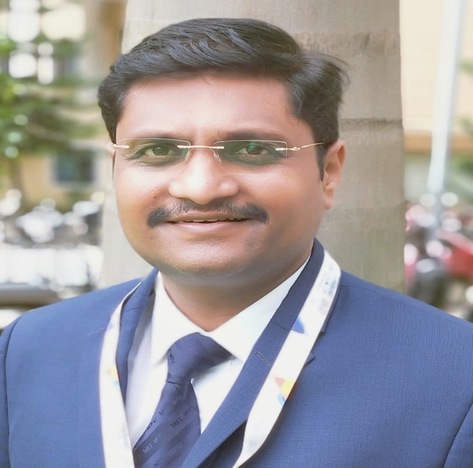
Dr. Prashant Pralhad Malavadkar
Professor & Program Director
Profile
Dr. Prashant P. Malavadkar is a Professor and Head of the Department of Mathematics and Statistics at Dr. Vishwanath Karad MIT World Peace University in Pune, India. He holds a Ph.D. in Mathematics, as well as an M.Sc., SET, and M.Phil. degree. Dr. Malavadkar has received several accolades for his research, including the IMS Prize for best paper at the 85th Annual Conference of IMS, and the Best Paper Award at the 19th ICMCSE in Berlin, Germany. He is a Life Member of the Indian Mathematical Society and the Academy of Discrete Mathematics and Applications, and has served as a member of the Board of Studies at Sadhu Vaswani Mission's St. Mira's College for Girls in Pune.
Research Areas :
Matroid Theory, Graph Theory, Combinatorics and Discrete Mathematics.
Web Page :
https://sites.google.com/view/prashantmalavadkar/home
Google Scholar Link :
https://scholar.google.com/citations?user=r4Xog48AAAAJ&hl=en&oi=sra
Scopus Link :
https://www.scopus.com/authid/detail.uri?authorId=37056044300
Web of Science Link :
https://www.webofscience.com/wos/author/record/2068007
ORCID :
https://orcid.org/0000-0001-7706-3286
Publications :
Uday Jagadale, Amruta Shinde, and Prashant Malavadkar, h-Extra r-Component Connectivity of 3-Ary n-Cubes, Journal of Interconnection Networks, https://doi.org/10.1142/S0219265924500154.
S. Gunjal, P. Malavadkar and U. Jagadale, On connectivity preserving splitting operation for matroids representable over GF(p), South East Asian J. of Mathematics and Mathematical Sciences 20 (1) (2024), 261-272.
V. K. Kalyani, S. Gunjal and P. Malavadkar, Neural Networks Learning Approach to Solve Cauchy's Differential Equations, Bull. Comput. Appl. Math. 12 (1) (2024).
P. Malavadkar, S. Gunjal, U. Jagadale, M. M. Shikare, B. N. Waphare, The es-splitting Operation for Matroids Representable Over Prime Fields GF(p), Combinatorics, Graph Theory and Computing SEICCGTC 2021 448 (2024), 1–10.
A. P. Narke, P. P. Malavadkar, M. M. Shikare, I. Gutman, On path-Equienergentic graphs, Bull. Int. Math. Virtual Inst., 13(2)(2023), 233–237.
S. Gunjal, U. Jagadale, P. Malavadkar, Generalized splitting and element splitting operations on p-matroid, The Mathematics Student Vol. 92, Nos. 3-4, July-December (2023), 175–186.
SJ, V. K. Kalyani, K. Naik, P. Malavadkar, Effects of Artificial Boundaries on SH-Waves Propagation in a Weiskopf type Anisotropic Liquid-Filled Porous Medium, The Journal of Indian Geophysical Union 27 (2) (2023), 96-108.
P. P. Malavadkar, S. B. Dhotre and M. M. Shikare On n- connected minors of the es-splitting binary matroids, Electron. J. Graph Theory Appl. (EJGTA) 9 (2) (2021), 265–275.
P. P. Malavadkar, S. B. Dhotre and M. M. Shikare The closure operator, flats and hyperplanes of es-splitting matroid, Journal of the Indian Math. Soc. (JIMS), Vol. 88, Nos. (3 - 4) (2021), 334–345.
P. P. Malavadkar, S. B. Dhotre and M. M. Shikare, Forbidden-minors for the class of cographic maroids which yield the graphic element splitting matroids, Southeast Asian Bull. Math. 43(1) (2019), 105-119.
M. M. Shikare, P. P. Malavadkar, S. C. Patekar and I. Gutman, On the path eigenvalues and path energy of graphs, Match Commun. Math. Compt. Chem. 79(2) (2018), 387-398.
P. P. Malavadkar, M. M. Shikare and S. B. Dhotre, A Characterization of Cocircuits of an es-Splitting Matroid, J. Comb. Math. Comb. Comput., 105 (2018), 247-258.
S. B. Dhotre, P. P. Malavadkar and M. M. Shikare, On 3-connected es-splitting binary matroids, Asian-European J. Math. 9(1) (2016), 1650017 1-10.
P. P. Malavadkar, M. M. Shikare and S. B. Dhotre, A characterization of n-connected splitting matroids, Asian-European J. Math. 7(4) (2014), 14500601-7.
M. M. Shikare, S. B. Dhotre and P. P. Malavadkar, A Forbidden-minor characterization for the class of regular matroids which yield the cographic es-splitting Matroids, Lobachevski J. Math. 34(2) (2013), 173–180.
A. M. Dhere, C. A. Shingte, P. P. Malavadkar and J. A. Pawar, Application of Software Technology for Air Pollution Prediction Model, Nature, Environment and Pollution Technology 10 (1) (2011), 77-79.


 admissions@mitwpu.edu.in