Designing the Future: The Growing Importance of Semiconductor and VLSI Skills

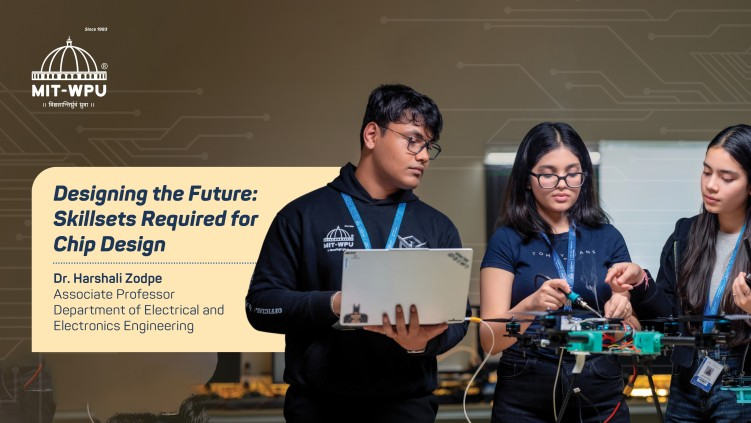
Semiconductor chips are silent passengers in nearly every modern advance, yet they power almost anything with the potential to change our future.
Artificial intelligence. Electric vehicles. IoT. 5G and 6G. Robotics. Smart healthcare. High-performance computing. All of these need a strong semiconductor design to provide.
This is precisely the reason why Semiconductor and VLSI Design has lost its so-called niche status. It has an emerging field of engineering for the next generation.
India is at a significant and pivotal juncture in its developmental trajectory. The Government of India claims that the value of the semiconductor market in the country was about $38 billion as of 2023, grew massively to an estimated range of approximately $45 to 50 billion over the period between 2024 and 2025, and will continue to grow significantly with expectations reaching a valuation of anywhere from $100-$110 billion by 2030.
Moreover, in terms of policy initiative, this is a strategic policy direction which further establishes that India is progressively and systematically emerging as a major global semiconductor hub internationally against the background of its determined quest for advancing, growing and enabling its intrinsic position in the international space concerning the long-term relevance for national advancement and destroying semiconductor contemporary day merchandise trends.
Why Class 12 Students Should Consider Semiconductor & VLSI Design
What is even more telling, as stated by the Ministry of Electronics and IT, is that it has become home to nearly 20% of the global chip design engineers. Above all, that is a strong signal for students considering future-ready engineering pathways.
This is an important area for students in Class 12 who are serious about their future to keep a tab on.
It's not just following the field into chip design. It is about striking the right mix of knowledge, experience and outlook.
Core Skills Every Future Semiconductor Engineer Needs
A strong foundation remains essential. This needs to be done with students getting an idea on analog and digital electronics, semiconductor physics, algorithmic aspects of circuit behaviour, signal processing and system optimisation topics. These are not optional layers. They are the foundation of everything that follows in chip design.
From there, we go into digital system design, Verilog and VHDL hardware description languages, and design verification before ending up in embedded systems and computer architecture. These are the skills that take students from theory to real-world design logic.
But classroom learning is not the only thing.Hands-On Learning and Multidisciplinary Thinking
This field rewards hands-on learners. Students learn quickly if they create, emulate, examine, troubleshoot or enhance. Implementing a project on an FPGA, the basic design of a processor with circuit simulation or verification flow teaches far better than theoretical learning. When students get to see theory in real engineering, confidence becomes genuine.
Students learn to think across disciplines through chip design, too. Good engineers in this area need to take a perspective from outside the circuit. Power consumption, signal integrity, thermal considerations, materials (hard and soft), embedded intelligence: These all matter. That is why the top tier of semiconductor talent has depth AND scope.
Soft skills matter too. Semiconductor work is highly collaborative. Engineers interact across teams, tools and sometimes even geographies. Professional success in this space involves clear communication, teamwork, proper documentation and disciplined problem solving.
And this is where finding the right academic environment can be extremely conducive.
Industry-Ready Education at MIT-WPU, Pune
The B.Tech Electronics (Semiconductor & VLSI Design) Programme at MIT-WPU, Pune, has been designed with an industry-ready semiconductor professional building in mind. The programme combines fundamentals of electronics engineering, semiconductor device physics and VLSI design techniques while being in line with developments around the world on chip design and fabrication, as well as the India Semiconductor Mission. Exposure to tools and platforms like Synopsys, Cadence, Mentor Graphics and FPGA platforms is also provided to students. This is especially relevant given the multilevel structure of the programme.
What Sets This Programme Apart
Major tracks offered by this programme include semiconductor device design and fabrication, VLSI design and verification, embedded systems and SoC design; AI/ML for chip design and semiconductor manufacturing, and photonics and quantum electronics. That kind of breadth is reflective of what the industry increasingly wants from future engineers.
This direction is further supported by the academic ecosystem as a whole. MIT-WPU's Department of Electrical and Electronics Engineering includes this specialised B.Tech offering within a broader technology-driven department, and well-equipped state-of-the-art labs providing practical experience in VLSI design, embedded systems, IoT, and AI computing, among others.
For students, that matters.
Because the landscape of semiconductor education from now on will not just be theoretical. It will be defined by institutions that offer an infusion of academia with practice, tools, labs, projects and industry requirements.
This is also why internships, hackathons, research works and portfolio building should be of utmost attention than ever before. Employers gradually seek students who can demonstrate what they have created, experimented with or addressed. As it turns out, in an industry like chip design that's as reliant on precision as a surgeon's scalpel is to the operating theatre, proven ability means something.
What, then, should students learn from all this?
A Strategic Career Choice for the Long Term
Semiconductor and VLSI design is a big long-term bet.
First, semiconductor and VLSI design is a serious long-term opportunity, not just a passing trend.
Second, success in this field demands dedication and continuous learning.
Third, choosing the right programme can make a real difference in how quickly students become industry-ready.
At a time when the world is being redesigned through intelligent systems, connected devices, and advanced computing, semiconductor engineers will remain central to that progress.
The future is being designed at the chip level.
And for students who are curious, disciplined, and ready to build, this is one of the most meaningful places to begin.


 admissions@mitwpu.edu.in