How Wearable Technology Meets Fashion Design: Fashion, Creativity, and Engineering
There are three pillars on how wearable technology can meet fashion design-a) you can have a product category of high-potential products; b) the strategic business model is in ‘Fashion and Tech’; and c) there is an unending stream if you are tapping into Indian opportunities. Honestly, facing more challenges will open more opportunities for innovation. And overcoming the challenges is the hardest part.
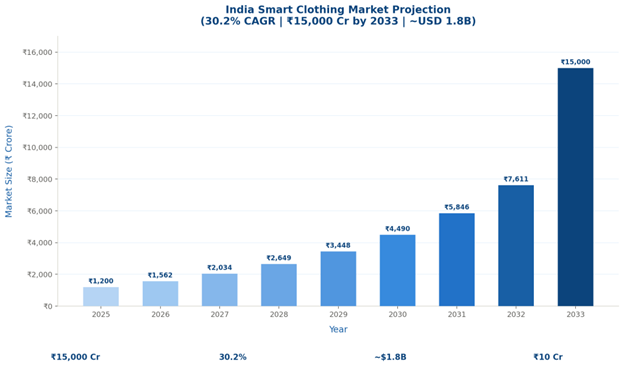
One thing is for sure: if you want to see the industry touch ₹10 Cr, then you have to shift from attaching the gadgets to clothes to an actual seamless integration of technology and textile, as in fashion. This invisibility will add functional value as well as help in maintaining the aesthetics of fashion.
The following graph shows the growth of the market in wearable technology and fashion design for the coming decade.
Fabrics and silhouettes are not the only elements of the fashion industry. Today, this industry falls at the intersection of AI, understanding of data-driven retail, and smart materials. And the professionals who have an understanding of both the design and the ever-evolving technologies are the people who actually get to taste the existing careers in this industry.
With that said, welcome to the world of fashion and technology, and let’s dive deep into wearable technology and fashion.
Category: High-Potential Products
You will be entering this category of market only if you can combine style and utility, like wellness, connectivity, or performance.
- Smart Activewear : This category happens to be the largest segment of the active wearable market. Typically, this clothing involves sensors keeping track of muscle activity, heart rate, body temperature and so on. This category is more appealing to the increasing health-conscious population of India.
- Intelligent Ethnic Wear : This category embeds sensors into traditional/ethnic clothes to track postures or vitals.
- Smart Accessories : The range of smart accessories, like rings, watches, bracelets, brooches, etc., that track sleep, deep sleep hours, and wellness.
- Functional Apparel : These are the kinds of clothes that change the temperature, colour, or shape based on the environment that the user is in.
Strategic Business Model in Fashion-Tech
The whole game of fashion-tech is going to be based on premium brand positioning. Additionally, the product margin must be high.
- Data Premiumisation : It's always the emotions that get sold, followed by the products. So when creating a strategy in this category, you need to sell wellness before the product. Similar to the Oura ring model, the smart clothes should be given subscriptions to access the personal insights of health data.
- Sustainability as USP : Appealing to the eco-consciousness of Gen Z, for sustainability, we can make use of smart tech to create a fabric that can self- clean and take care of its own wear and tear. This will also contribute to sustainability by reducing waste in the bigger picture.
- Collaboration : The great collaboration that can happen is between the tech companies providing the sensors, conductive threads and apparel brands for established distribution channels and creative designers.
- Hyper-personalisation : AI can be used for custom-fit garments through body scanning. This not only helps in personalisation of outfits but also helps in reducing the inventory cost and increasing its value.
What Does a Fashion Technology Career in India Look Like?
In India, working in fashion technology means working at the intersection of design creativity and cutting-edge innovative technology. It involves everything from designing smart clothes with sensors and collecting data related to your health to predicting runway trends by building AI tools to even engineering textiles on a sustainable level at a molecular level.
The current textile industry in India is valued at ₹12 lakh crore, and it is predicted to touch ₹21 lakh crore by 2030. Within this tech-enabled segment of digital fashion, wearable technology, etc., is growing fast. This decade is the right time to enter the fashion-tech industry for students exploring a fashion technology career in India.
Fashion Technology Career Opportunities
India is expected to become one of the most exciting textile-tech hubs in the world. From home studios to apparel exporters and retail tech start-ups, here’s a breakdown of career paths in India for fashion tech:
Fashion Designer : Today’s fashion designers are working in 3D prototyping software and sustainability at the same time. Fashion designers are also expected to be technologically – digitally – sound along with being creative.
Textile Technology and Innovations : Textile technology might sound new, but it has been a science since way back, at least in India. So, creating moisture-wicking fabrics, antibacterial clothes, and now the increasing demand for smart clothing embedded with biosensors, is real and comes under textile technology and innovations. Designers who have an understanding of both these areas fall under the pay bracket of ₹4-8 LPA at the initial stage, which will further increase depending on the technological knowledge and the creative experience they bring to the table.
Fashion Merchandise and Retail : Merchandising bridges the gap between fashion design and the customer experience. Putting together the analytical data of the inventory, prices of the merchandise, and the region of demand makes selling easy. With popular e-commerce platforms, scaling has not remained an issue anymore. By the way, the demand for smart clothes and tech-savvy merchandise has increased a lot in the last 5 years.
Digital Fashion and AI : 'Digital fashion' literally means that the clothes have digital tracking and sensors on them. Wearable tech designers are creating such garments to keep track of your health metrics, responses to the changing environments, etc. A smart clothing career means working for huge brand names like Adidas, Puma, Nike, Google or any Bangalore-based startup. For these jobs, the salary base starts with ₹6 LPA to ₹18+ LPA, depending on the experience in a similar industry.
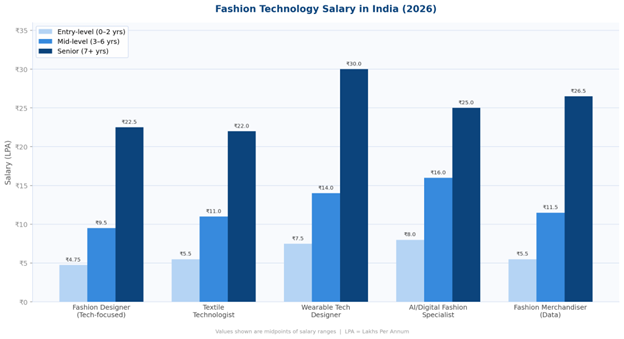
Digital Fashion Salaries in India: (Data based on 2026 survey)
Skills Required for Fashion Technology :
- Design Fundamentals : You must be well-versed in design fundamentals, such as making patterns, colour theory, and creating different garments.
- Digital Tools : An understanding of tools like Adobe Suite, CLO3D, Browzwear, and Optitex is a must.
- Material Science : Knowledge about textiles, smart fabrics, sustainable fabrics, and the knowledge about nanotechnology is again a must.
- Data Handling : Data literacy is important while dealing with technology and innovations, along with trend analysis, consumer behaviour data, etc.
- Business Acumen : You must be aware of supply chain management, distribution channels, calculations for retailers, and brand strategy.
- Coding basics : Arduino for wearables is in demand increasingly, along with Python for AI.
MIT-WPU Edge : MIT-WPU, Pune, offers an undergraduate programme ‘B.Des. Fashion and Apparel Design’ that offers a unique and contemporary curriculum. This programme also blends design with technology and offers the following major tracks :
- Textile Processes
- Fashion Merchandising
- Fashion Design
- Garment Construction
- Apparel Manufacturing
For more information about the course, please visit the website: HERE!
Challenges to Overcome in the Wearable Fashion Industry
Since this is a very new industry to tap into, not many players are in the game. Having said that, the players that are already in this game are the international ones, and there is no way any start-up can compete with them at the start-up stage itself. So there is a lot of scope in R&D in this industry.
There are a lot of opportunities if you are thinking of starting to play in this league; the following are some of the areas to consider:
- Durability : Since these are clothes we are talking about, it is pretty clear that we need to be able to wash them regularly. Also, it should be able to take the wear and tear that happens over time.
- Data Privacy : High-end data security should be provided since you will be collecting health-related data from people.
- Invisible Tech : The technology that will be used in the clothes should be sleek as per the demand, since it will be placed in fashionable clothes.
Conclusion
Fashion is no longer limited to fabrics and trends—it is becoming a technology- driven industry powered by innovation, data, and smart materials. As wearable technology continues to grow, professionals who can combine creativity with technical expertise will be in high demand. For students exploring a fashion technology career in India, this emerging field offers exciting opportunities to shape the future of fashion.
FAQ
Q1. What is Wearable Technology in fashion technology?
Ans. Clothing, accessories or textiles can come under 'wearable technology' in fashion, with the integration of sensors, smart fabrics, Bluetooth for connectivity features, etc. The goal is to combine style with functionality that will give users access to track health-related metrics.
Q2. In fashion technology, what are the career opportunities you can look for in India?
Ans. There are diverse career opportunities for fashion technology in India, including fashion designing, textile innovation, digital fashion, wearable technology, merchandising, retail analytics, and AI-driven fashion solutions. The growing fashion industry has demand for creative and technical skills.
Q3. For a successful fashion technology career, what are the skills required?
Ans. A combination of design fundamentals, digital design tools, knowledge of textiles and materials, business understanding and basic knowledge of coding is the formula for a successful career in the fashion industry. A keen interest in AI, smart fabrics, creativity and sound technical knowledge with a hint of curiosity would help in innovation in the wearable fashion sector.
Q4. What is the role of AI in transforming the fashion and wearable technology industry?
Ans. Through personalised garment recommendations, trend forecasting, custom- fit clothing for body scanning, optimisation of inventory and creating wearable products, AI is basically transforming the fashion industry and its foundation. AI is also helping brands to improve the customer experience, which is ultimately helping to reduce operational costs.
Q5. For students interested in fashion and innovation, is wearable technology a good career option?
Ans. Yes, wearable technology is an emerging and high-growth field that combines fashion, engineering, and digital innovation. Students interested in creativity, technology, sustainability, and product development can find exciting opportunities in smart clothing, digital fashion, and textile innovation.


 admissions@mitwpu.edu.in