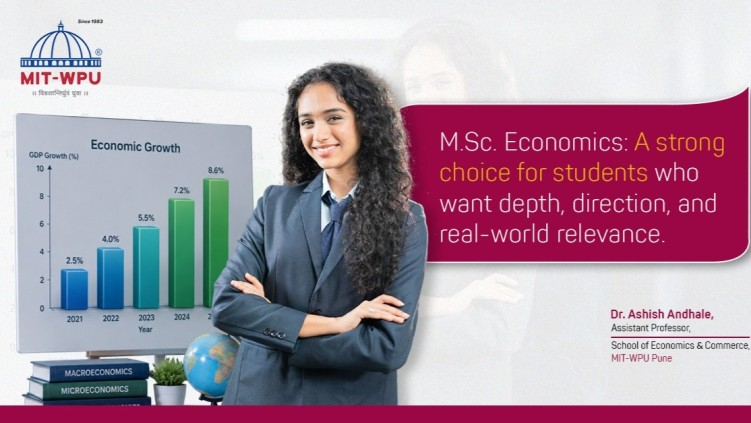
M.Sc. Economics: A Strong Choice for Students Who Want Depth, Direction, and Real-World Relevance
Economics is more than a theoretical text. Economics starts out as an issue for many students. It is much more than that at the postgraduate level. It becomes a lens for how the world works, how decisions are made, markets move, policy shapes everyday life, and data is leveraged to make sense of change.
That is the hallmark of a good M.Sc. Economics programme and why it is so important. It has to be a little beyond concept teaching. This will help students comprehend and then analyse, to apply ideas to the world around them. In fact, that larger purpose is what has shaped the M.Sc. Economics programme at MIT-WPU, Pune. Combining academic rigour with applied learning, technical tools and a future-oriented perspective, it provides students with a postgraduate experience that is genuinely robust and relevant.
A strong foundation still matters
The fundamental principles are the starting point for any important economic expedition. Those basics need to be taken seriously at the postgraduate level. Before students can go into more advanced areas, they must be fluent in microeconomics, macroeconomics, mathematics for economics, statistics and research methodology.
This is something that makes this programme capable of standing out. Students graduate with a strong foundation in fundamental economic theory, but professors also help them create an analytical mindset. This is important because economics is not merely about rote memory for models. It is about recognising the significance of those models and their relevance, as well as recognising that reality has far more nuance than a theoretical model.
At MIT-WPU, Pune, students go through this way, but it is a structured yet unstructured process. It is deep enough to challenge them, but varied enough to keep it interesting.
The programme looks past traditional economics
A postgraduate should look beyond the comfort zone. This should also bring students into fields which are representative of the current economy. The M.Sc. Economics programme achieves this by incorporating current topics like labour economics, health economics, green economics, derivatives and risk analysis.
It matters because today the economy connects a lot more than just markets. It is connected with sustainability, health, jobs, finance, energy and social change. Those connections need to be visible to students studying economics at this level. One that combines classical theory with contemporary issues equips them to approach questions like an economistone who thinks like an economist, but one also aware of the modern world.
That balance makes for more meaningful learning. This also helps students transition to careers in which they will have to analyse nuanced scenarios and respond meaningfully.
The degree has a purpose through applied learning
A key strength of the programme lies in its emphasis on applied learning. When students learn how to work with data, identify trends and apply the right tools to validate their conclusions, economics is much more valuable. That is precisely the reason why the programme introduces students to Python, STATA, R and Excel.
This kind of training is important, as it renders economics something other than an abstract science. The students can transition from theory to practical applications through it. Theory is not the only thing they are learning about how the economy behaves. They are also learning about identifying patterns, analysing data, and displaying insights in ways that have value for research, policy consulting and finance.
The programme comprises the above mentioned tools along with Internships, Dissertations, Workshops, and Paper Presentations. That blend allows students to engage in practical lessons and trust their own interpretation skills. There is a massive difference between comprehending the same concept in class. But it is one thing to describe it, justify it, and practice it in a controlled environment. And this programme does both.
The curriculum is kept relevant
Economics changes constantly. That a non-evolving programme gets old fast. This is why a curriculum with foresight in this regard matters so much.
The M.Sc. Economics at School of Economics & Commerce, aims to keep pace with the economic trends and industry requirements. The curriculum is updated regularly, with the help of economists and industry experts, so that learning does not become obsolete in three years. It captures the students who are then confident that what they are learning is not lost in time, but relevant to the world they go into.
It is also what makes the programme attractive to students with other ambitions. Some of the students might wish to go for higher studies and research. Some might be getting ready for competitive exams. Others might wish to go on directly into corporate, financial, or policy settings. A sound economics programme in any of those directions would back all of them and this one does.
Specialisations allow for room for guidance in a student's path
A higher degree is of greater benefit when it enables learners to immerse themselves in areas aligned with their interests. The M.Sc. subjects include financial forecasting and demography, security analysis and portfolio management, migration and urbanisation, financial economics, population and development, and financial risk management. All these are major tracks offering that kind of flexibility.
So, why do these tracks matter? Because economics is not a single career path. Finance is attractive to some students. Some are interested in policy. Some are inclined towards data, development, demographics, or research. They have a roadmap, but one that allows them to navigate toward their goals without pre-committing. A programme that provides this sort of guidance creates focus for students while allowing for flexibility and does not limit them to certain options only.
Research sits at the heart of the learning experience
At the postgraduate level, research is not a garnish. That sits at the heart of learning. The programme recognises that clearly. Students are trained in research methods, applied econometrics and dissertation work, so they earn the discipline and intellectual confidence that should come with any postgraduate study.
There are a handful of reasons why this research focus is important. It strengthens academic understanding. It allows students to be more inquisitive. It cultivates an independent mindset. It can also prepare them for doctoral study, policy positions and research-based careers if they want to take their education further than the master's level.
Equally important is that it teaches students how to work with evidence, not assumptions. That is a skill worth having in a world of opinions.
Industry interface makes this programme more real
Economics has linkages to the world of business, policy, finance and decision-making processes in public. Students need to see that connection in action. With a very good industry-academia interface, guest lectures, seminars, and industry visits with the numerous corporates that MIT-WPU has managed to build over time, to work together on many collaborative projects.
Exposure like that matters because it shows students how economics works outside the classroom. They start to realise how businesses think, how institutions make decisions and where economic insight fits into actual jobs and organisations. It also provides them with a better sense of where their own strengths may belong.
For many students, this is when economics stops being just a subject and starts to be a career choice.
Extra value from global exposure
Good economics degrees are also about preparing students for the world at large. That global dimension is what MIT-WPU, Pune, adds via collaborations with Helwan University, Cairo, Egypt, along with opportunities linked to the Investment Foundations Certificate from the CFA Institute, USA.
It matters because economics does not function in a vacuum. The interconnections of markets, policy, finance, trade and development have grown. Getting to an international perspective gives students a broader way of thinking and allows them to better see how ideas travel across contexts.
Further broadening students' knowledge of finance and investment is the Investment Foundations Certificate. That can be particularly useful for students interested in things like financial analysis, risk and such.
The programme supports many possible futures
This degree also offers one of the most diverse career paths, such as Environmental Economist, Industrial Economist, Macroeconomist, Econometrician, Urban Economist, Development Economist and Financial Risk Analyst, as well as Investment banker, Corporate Finance Manager/Director (e.g., CFO), Financial Consultant, Research analyst, Market research analyst, Business analyst, Actuarial analyst, and in Financial Services.
That kind of range is important because it offers possible growth paths along the way. This shows that the programme is not intended for one specific outcome. It is intended to support a variety of professional paths based on each student’s interests and strengths.
The overall experience feels purposeful
What makes the M.Sc. Economics programme at MIT-WPU, Pune, is appealing in the way it combines so many important elements in one place. It has a strong core theory, relevant specialisations, practical training, research depth, industry exposure, global linkage, and clear career relevance. It does not treat postgraduate education as a formality. It treats it as a serious step in a student’s intellectual and professional development.
That is what a good master’s programme should do.
Conclusion
For students who want to study economics at a deeper level and also prepare for meaningful careers, the M.Sc. Economics programme at MIT-WPU, Pune, offers a thoughtful and well-rounded pathway. It is academically strong, practically useful, and designed with the future in mind. Most importantly, it helps students build the kind of confidence that comes from understanding both the theory and the real world behind it.
For anyone who wants economics to become a serious academic and professional journey, this programme offers a very strong place to begin.


 admissions@mitwpu.edu.in