500 GW by 2030: India’s Green Leap towards becoming a Superpower
You must have heard terms like ‘renewable energy’ or ‘clean energy’ a lot lately in the news, in school, maybe even at your dinner table. But what does it really signify? Consider it like this much of the energy that energises our houses, appliances, and devices is generated from the combustion of coal or oil. Burning these fuels generates electricity; however, it also emits significant smoke and harmful gases into the atmosphere. Additionally, these non-renewable resources are finite, meaning that once they are depleted, they cannot be replenished.
Renewable energy, conversely, is derived from sources that nature continuously replenishes, such as sunlight, wind, rivers, and organic waste. According to these sources, a solar panel captures sunlight and transforms it into electricity. A wind turbine those tall structures with rotating blades you may have noticed along highways produces electricity from the flow of air. In the same way, hydropower stations harness the power of river currents to produce electricity. All these instances discuss the use of renewable energy. They generate no harmful gases - they are more environmentally friendly and, crucially, will never be depleted.
Now that we have got the basics covered, let us talk as to how India will achieve all of this.
India's Big Green Movement
India, home to 1.4 billion individuals with an increasing demand for energy, has stealthily emerged as a major force in global renewable energy. As per the Ministry of New and Renewable Energy (MNRE), India's total renewable energy capacity installed has hit 220 gigawatts (GW) by March 2025. To illustrate this scale, one gigawatt can supply power to approximately 7 to 8 hundred thousand homes. Thus, 220 GW represents a vast quantity of clean energy. India currently holds the fourth position globally in total renewable energy capacity, following China, the United States, and Brazil.
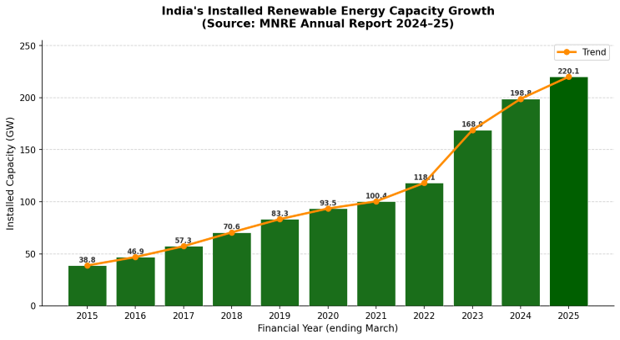
Figure 1: How India's Renewable Energy Capacity Has Grown Year by Year | Source: MNRE Annual Report 2024–25
Solar Energy: India's True Star
Of all the renewable sources, solar has been India's biggest success story. Our nation receives tremendous sunshine throughout the year and we are now effectively utilising that on a large scale. In the fiscal year 2024–25, India installed almost 24 GW of additional solar capacity. According to MNRE data, the total installed solar power capacity in India exceeds 105 GW. Regions such as Rajasthan and Gujarat, known for receiving some of the most intense sunlight globally, are at the forefront. Rajasthan has more than 34 GW of renewable energy capacity, primarily generated by solar farms that extend for miles.
The government’s PM Surya Ghar scheme is also bringing solar power directly to people's rooftops helping one crore (10 million) households get free electricity from the sun. With over 50 GW installed turbines, wind energy is growing as well, and states like Tamil Nadu have been major contributors for this alternative source of energy.
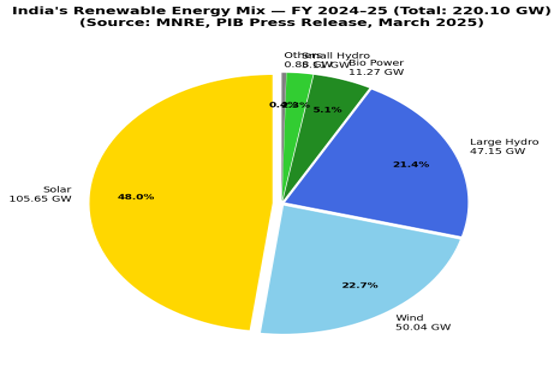
Figure 2: What Makes Up India's Renewable Energy. The Full Mix (FY 2024–25) | Source: MNRE, PIB 2025
The Money and Jobs Behind It
Renewable energy benefits not only the environment but also the economy. Since 2014, government-supported financial bodies have invested around Rs 10.79 lakh crore into renewable energy initiatives throughout India. In just FY 2024–25, an investment of Rs 2.68 lakh crore was made all within one year.
At this rate of growth, this industry is certainly generating employment swiftly. The MNRE forecasts more than 38 million job vacancies worldwide in renewable energy by 2030. In India, countless engineers, technicians, and project managers are currently employed in solar parks, wind farms, and energy storage enterprises. Emerging areas such as green hydrogen where clean energy is utilised to produce hydrogen fuel are anticipated to generate significant economic activity, with projected investments of Rs 8 lakh crore and as many as 6 lakh new jobs by 2030.
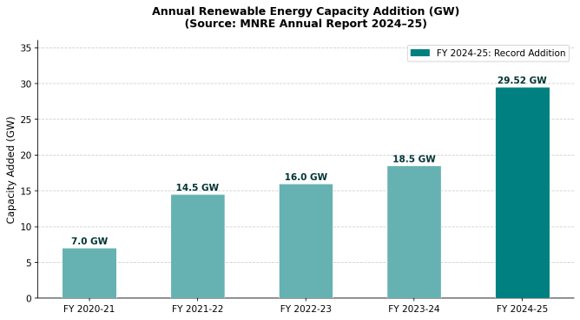
Figure 3: India's Annual Renewable Capacity Addition, A Record Year in FY 2024–25 | Source: MNRE Annual Reports
India's Renewable Energy Journey: The Challenges Involved
The incredible numbers mentioned above, in the energy sector is not going to be an easy path. India's renewable energy journey has real problems, and it is important to address them honestly.
i) The Grid Cannot Always Handle It
Here is a simple way to think about the grid problem. Imagine a highway that was built for 1,000 cars a day. Suddenly, 5,000 cars show up. Now, there is a traffic jam not because there are enough cars, but because the road was not built to handle so much congestion. That is exactly what is happening with India's electricity grid. Renewable energy is being produced faster than the transmission lines and substations can carry it to homes and factories. Around 50 GW of clean power is sitting ‘stranded’ across India because it has nowhere to go, according to energy analysts at IEEFA (2025).
ii) Getting Land Is a Real Headache
Building a large solar farm requires a large amount of land which is flat, open, and receives abundant sunlight. In a country like India, where land records are often messy, ownership is disputed, and many farmers depend on the same piece of earth for their livelihood, getting approvals and clearances can take years. This challenge slows down the project timelines significantly.
iii) We Still Depend on China for Raw Materials
Almost 80% of the solar panels installed in India are made using components imported from China. This can put us in a vulnerable state, in case the trade relationship changes or prices spike. The government is trying to fix this dependency by encouraging domestic manufacturing through its PLI (Production Linked Incentive) scheme, but building a full supply chain at home will take time.
iv) Storing Energy Is Still a Challenge
Solar panels only work when the sun is shining. Wind turbines only spin when the wind blows. But people need electricity at night and on calm days too. The solution is battery storage but India has very little of it as of now. As of 2024, India had only 0.2 GWh of battery storage capacity, while experts say it needs over 236 GWh to properly balance the grid. Closing that gap quickly is one of the most urgent tasks ahead.
Shaping the Engineers of Tomorrow: MIT-WPU, Pune’s Role
All of this growth needs one more critical ingredient skilled and well-trained engineers who understand both the technology and the real-world challenges of clean energy. MIT World Peace University (MIT-WPU) Pune, established in 1983, is one of India's most reputed engineering institutions offering a dedicated programme addressing this need. The university offers a full-time B.Tech Renewable Energy programme under its Department of Electrical and Electronics Engineering. The programme teaches students everything from solar and wind systems to smart grids, e-mobility, green hydrogen, and energy storage blending classroom learning with hands-on lab experience and industry internships.
MIT-WPU’s campus also has a Renewable Energy Lab, Smart Grid Systems Lab, a Green Hydrogen Research Centre, a Battery Fabrication System, and a SIEMENS PLC Lab offering its students practical exposure relevant for career progression and growth. This programme opens the door to careers at leading companies like Schneider Electric, Adani Power, ENGIE India, Emerson, and many more. In a country racing toward 500 GW of clean power, the engineers trained here will be building India's green future one project at a time.
What the Future Looks Like: Final Take!
Despite innumerable challenges, the direction is clear, and the momentum is strong. India has set a target of 500 GW (installed power capacity) for renewable energy by 2030 and with over 169 GW already in the pipeline, and with a cumulative effort of government and private sector, this goal looks achievable. By November 2025, India had already crossed 262 GW of non-fossil fuel power capacity meaning for the first time ever, more than half of India’s electrical capacity comes from clean sources. That is a historic milestone, and is a sign that India is moving in the right direction becoming a self-sufficient ecosystem by 2030. From the deserts of Rajasthan to the coastlines of Gujarat, from rooftop panels in Mumbai to wind turbines in Tamil Nadu a green revolution is underway. It is not perfect, but it is real, and it is accelerating.


 admissions@mitwpu.edu.in