Department of Pharmaceutical Sciences

Menu
About
Department of Pharmaceutical Sciences is consistently ranked amongst the top 100 institutions for Pharmacy in India for last five years by National Institutional Ranking Framework (NIRF), Ministry of Human Resource and Development. Department of Pharmaceutical Sciences offers comprehensive programmes at the undergraduate, postgraduate, and doctoral levels governed by Pharmacy Council of India (PCI) regulations and shaped by insights from industry experts, the curriculum emphasises modern and future-oriented technical knowledge, complemented by essential soft skills. The pedagogy fosters a proactive learning environment, focusing on critical thinking, problem solving, adaptability, emotional intelligence, creativity.
Vision
To prepare future leaders in health sciences and well-being through excellence in teaching and learning, research and innovation, service, and value system.
Mission
- To impart quality, futuristic, and industry-relevant education through an inspirational and learner-centric environment.
- To develop lifelong learners with innovative thinking, problem-solving abilities, professional competencies, and an entrepreneurial mindset.
- To nurture ethical, responsible, and socially conscious professionals who contribute meaningfully to society through continuous learning and value-based practice.
Program Educational Objectives (PEOs)
- PEO 1 KNOWLEDGE : To equip the students with the knowledge, skills and research aptitude required to successfully compete for entry level positions in industry or pursue higher education like MS, M. Pharm and other degrees in the related fields
- PEO 2 PROFESSIONAL ETHICS : To equip the students with professional integrity and ethical values so that they become responsible pharmacy graduates
- PEO 3 INNOVATION AND ENTREPRENEURSHIP : To engage the students in innovative activities by using ingenious thinking so as to envision better ways of accomplishing professional goals.
- PEO 4 LIFE LONG LEARNING : To provide contemporary professional skills and encourage life-long learning, including hands on laboratory experience to successfully compete in local, national and international pharmaceutical market. The students shall continuously strive to expand his or her knowledge to maintain professional competence.
- PEO 5 LEADERSHIP AND TEAM WORK : To inculcate the ability to function effectively, both as team member and as leader at the workplace and demonstrate appropriate interpersonal behaviour.
Programme Outcomes (POs)
- PO1 Pharmacy Knowledge: Possess knowledge and comprehension of the core and basic knowledge associated with the profession of pharmacy, including biomedical sciences; pharmaceutical sciences; behavioral, social, and administrative pharmacy sciences; and manufacturing practices.
- PO2 Planning Abilities: Demonstrate effective planning abilities including time management, resource management, delegation skills and organizational skills. Develop and implement plans and organize work to meet deadlines.
- PO3 Problem analysis: Utilize the principles of scientific enquiry, thinking analytically, clearly and critically, while solving problems and making decisions during daily practice. Find, analyze, evaluate and apply information systematically and shall make defensible decisions.
- PO4 Modern tool usage: Learn, select, and apply appropriate methods and procedures, resources, and modern pharmacy-related computing tools with an understanding of the limitations.
- PO5 Leadership skills: Understand and consider the human reaction to change, motivation issues, leadership and team-building when planning changes required for fulfillment of practice, professional and societal responsibilities. Assume participatory roles as responsible citizens or leadership roles, when appropriate, to facilitate improvements in health and well-being.
- PO6 Professional Identity: Understand, analyze and communicate the value of their professional roles in society (e.g. health care professionals, promoters of health, educators, managers, employers, employees).
- PO7 Pharmaceutical Ethics: Honor personal values and apply ethical principles in professional and social contexts. Demonstrate behavior that recognizes cultural and personal variability in values, communication and lifestyles. Use ethical frameworks, apply ethical principles when making decisions, and take responsibility for the outcomes of those decisions.
- PO8 Communication: Communicate effectively with the pharmacy community and with society at large, such as, being able to comprehend and write effective reports, make effective presentations and documentation, and give and receive clear instructions.
- PO9 The Pharmacist and society: Apply reasoning informed by the contextual knowledge to assess societal, health, safety and legal issues and the consequent responsibilities relevant to the professional pharmacy practice.
- PO10 Environment and sustainability: Understand the impact of the professional pharmacy solutions in societal and environmental contexts, and demonstrate the knowledge of, and need for, sustainable development.
- PO11 Life-long learning: Recognize the need for, and have the preparation and ability to engage in independent and life-long learning in the broadest context of technological change. Self- assess and use feedback effectively from others to identify learning needs and to satisfy these needs on an ongoing basis.
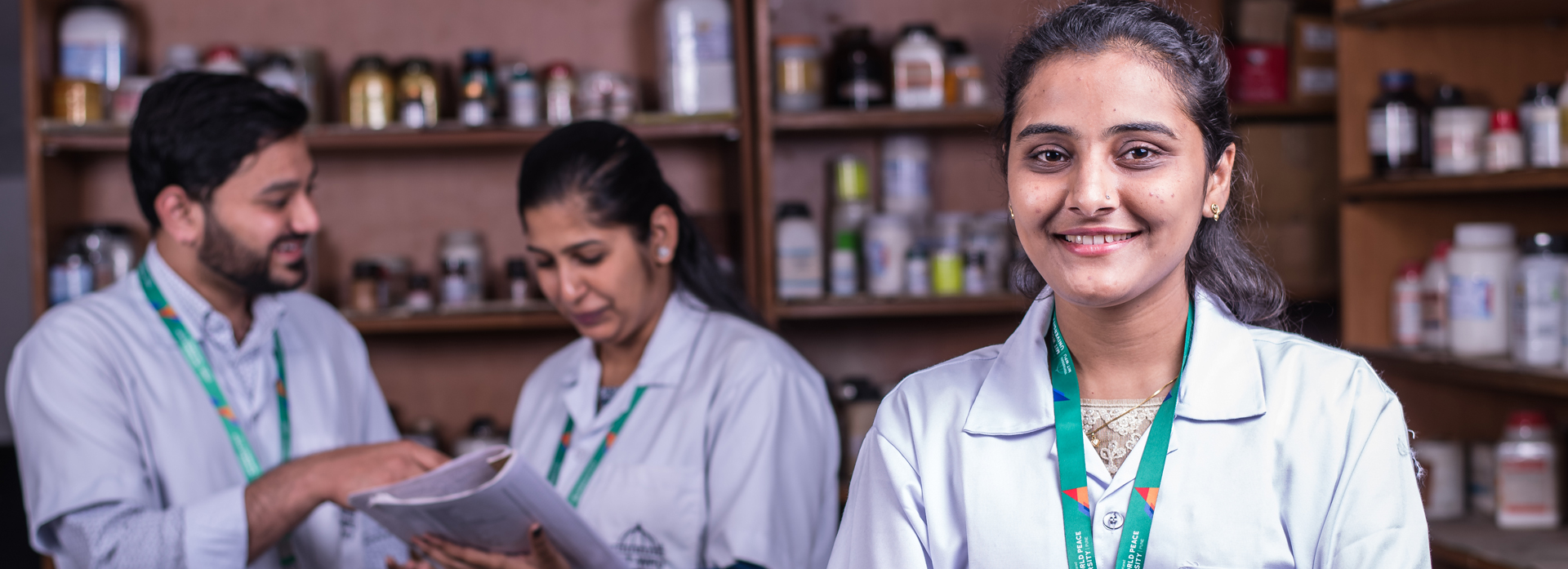
Every programme includes modules on peace studies and skill development as integral components. Students benefit from real-world exposure through internships, industry visits, and immersion programmes at local and national industries and academia facilitating interaction with practising professionals and researchers. Equipped with advanced laboratories, the department is home to an Adverse Drug Reaction Monitoring Centre (PvPI Centre) approved by the Indian Pharmacopoeia Commission. Students undertake internships and practice school at Multi speciality hospitals such as Vishwaraj, Lokmanya, Sahyadri, Ruby Hall Clinic, Jahangir, and Pharmacy chains like Unity Medicare, as well as industries such as NuLife, Emcure, honing their skills for a well-rounded education.
Our Objectives
- To equip students with knowledge, skills, and research aptitude to complete an entry-level position in the industry or pursue higher education.
- To engage in innovative activities by using ingenious thinking to envision better ways of accomplishing professional goals.
- To develop the ability to function effectively both as a team member and as a leader at the workplace and demonstrate appropriate interpersonal behavior.
- To develop the skills, knowledge, and ethics as future professionals in the field of pharmacy.
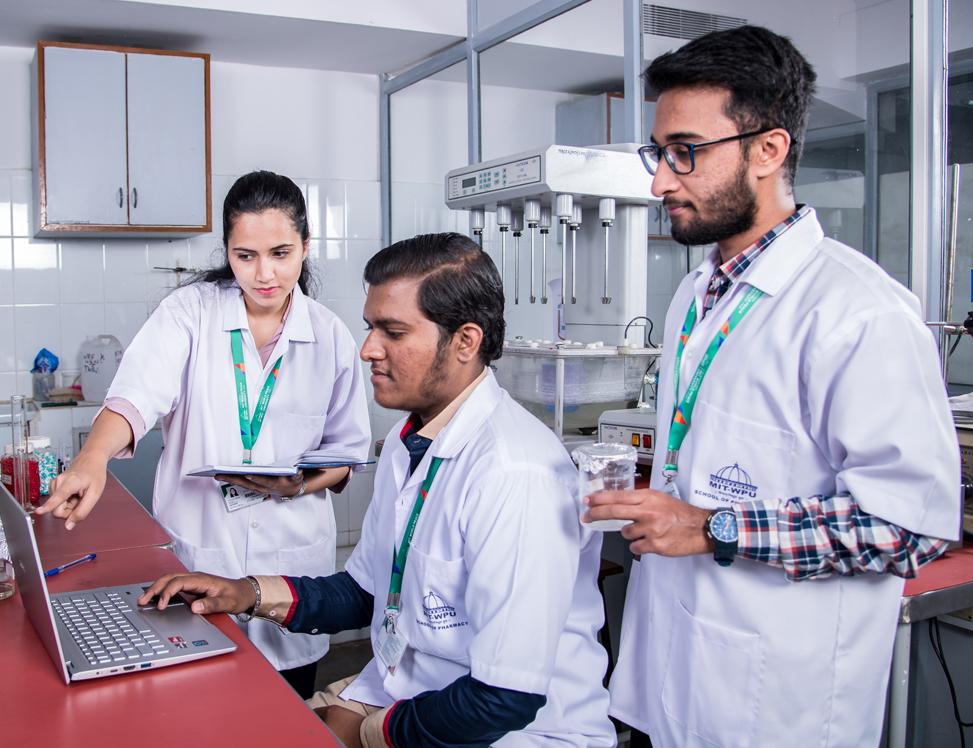
Major Career Tracks
- Industrial Pharmacist
- Manufacturing Research and Development Scientist
- Packaging, Quality control
- Quality assurance
- IT Pharmacist
- Hospital and Community
- Pharmacist
- Medical shops
- Drug distributors
- Sales and distribution executive


 admissions@mitwpu.edu.in